
The Lantern Post
Why Outdoor Play Does More for Your Child Than You Think
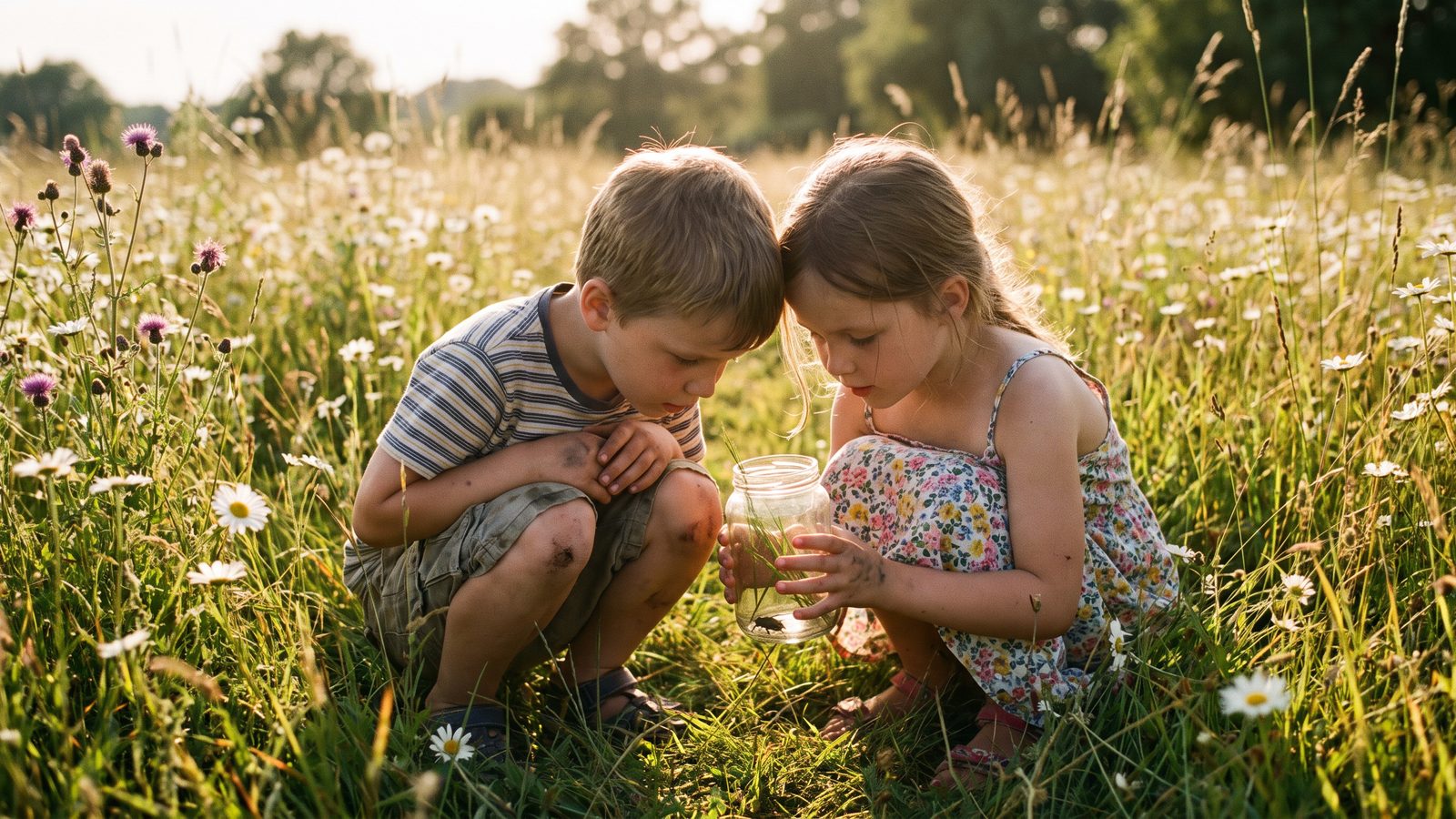
Your child comes in from the garden with grass stains, a scraped knee, and both hands cupped around something that is definitely still alive. Part of you reaches for the wipes. Another part notices they look calmer and more settled than they have all afternoon.
That second part is onto something. The muddy, aimless, hour-in-the-garden kind of outdoor play, the kind with no coach and no plan, turns out to be doing a surprising amount of quiet work. Not just burning energy. Protecting eyesight, most clearly of all. Sharpening tired attention. Easing things for a child who cannot sit still. And maybe, though this part is argued more than it is measured, building the sort of nerve that only comes from climbing a little higher than felt comfortable.
Here is what the research on outdoor play for children actually says, and why the messiest part of the day might be the most useful.
What an Hour Outside Does to a Tired Brain
By late afternoon, most children are running on empty. Not sleepy exactly. Frazzled. Short-fused. Unable to settle to anything for more than a minute.
There is a name for what is going on. Psychologists call it directed-attention fatigue. A whole day of focusing, following instructions, and holding still wears down the part of the brain that does effortful concentration, the same way a muscle tires. And the most promising place to recharge it is not a screen or a snack. It is nature.
This idea comes from Attention Restoration Theory, developed by Stephen and Rachel Kaplan at the University of Michigan. Their argument is that natural settings pull gently on our attention without demanding it. A swaying branch, a beetle crossing a path, the shift of light through leaves. The brain gets to rest the tired, effortful kind of attention and let it refill.
The theory has been tested most cleanly in adults. In a 2008 paper, Marc Berman, John Jonides, and Stephen Kaplan sent university students on a 50-minute walk, some through a quiet arboretum and some through the middle of town. After the nature walk, their scores on a demanding attention task went up. After the town walk, they did not. That is grown-ups, not children, but it is where the idea gets its legs. The child evidence is smaller and more tentative. In 2000, environmental psychologist Nancy Wells at Cornell followed 17 low-income children, aged 7 to 12, whose families moved to homes with more greenery nearby. She did not test their attention directly. Their mothers filled in a rating scale before and after the move, the scores improved, and the biggest change was linked to the biggest jump in nearby green. Wells calls it an exploratory study, with no comparison group, and asks openly whether it is a lasting effect or just the glow of a new home.
You do not need a forest for this. A patch of grass, a tree, a scrap of green at the end of the street. The dose is smaller than most parents assume.
Green Time and the Child Who Cannot Sit Still
This is the part that surprises parents most, especially the ones with a child who seems to have three extra gears.
Andrea Faber Taylor and Frances Kuo, researchers at the University of Illinois, have spent years looking at what green space does for children with attention difficulties. In a 2011 study, they surveyed the parents of 421 children with ADHD about where their kids typically played. The pattern was clear. Children who regularly played in green, leafy settings had milder symptoms than children who played indoors or on built, treeless playgrounds. It held across income levels, and for boys and girls alike.
An earlier study from the same team took 17 children with diagnosed ADHD on three matched 20-minute walks, one through a park, one downtown, one around a residential neighborhood, and tested their concentration straight after each. The park walk came out ahead of the other two, and the researchers noted that the size of that difference sat in the same range as the peak effect of two common ADHD medications. Two things belong right next to that. They measured only immediately after the walk, and they say plainly they have no data showing the effect lasts long enough to be of practical use. And in 2021, a pre-registered randomized trial with 24 children with ADHD looked for the nature benefit and did not find it, while the medication effect showed up clearly. That does not mean green time replaces medication. No family should ever change or stop a prescribed treatment based on a finding like this, and researchers describe outdoor time as a helpful add-on rather than a substitute.
So the evidence here is a mixed bag, and worth reading as one. The 421-child study is a parent survey, which shows a pattern and cannot show a cause. The walk study is small and controlled. The 2021 trial is the strongest design of the three and came up empty. What is left is a promising, unsettled idea about something free, pleasant, and available at the end of nearly every street.
The Eyesight Surprise Nobody Mentions
Here is a benefit almost no one connects to outdoor play, and it may be the most clear-cut of all.
Rates of short-sightedness, or myopia, have been climbing steeply in children around the world. And one of the strongest protective factors researchers have found is simple: time spent outdoors.
The numbers are striking. A review that pooled seven studies found that each extra hour a child spends outside per week goes with about two percent lower odds of being short-sighted. Those seven were snapshots rather than children followed over time, so read it as a pattern, not a promise. Schools have tested it directly. When one Taiwanese school sent its children outside for every recess and a neighboring school carried on as usual, new cases of short-sightedness over that year came in at roughly half the rate. That is two schools, not a trial. The randomized school trials that came after found something smaller and steadier, somewhere around 15 to 25 percent fewer children becoming short-sighted, in studies that added 40 or 80 minutes outdoors a day.
The leading explanation is light. Bright outdoor light is many times stronger than indoor lighting, even on a cloudy day, and the leading theory is that it triggers the release of dopamine in the retina, a signal that may help the eye grow to the right shape. Theory is the right word here. The people reviewing this research still say the mechanism is unknown, and the tidier explanation, that it is really about looking at things far away instead of a page up close, has much weaker support than the light one. Expert eye bodies recommend around 80 to 120 minutes outdoors a day. That is a practical target rather than a threshold anyone located in the data, and part of the reasoning is simply that sending a child outside costs nothing and carries no risk of its own.
It is worth sitting with that. The same habit that calms a restless afternoon may also be protecting the shape of your child's eyes.
Why a Little Risk Is Part of the Point
Watch a child at a playground and you will see it. They climb to the exact height where their face goes serious, pause, and decide whether to go on. That pause is not a problem to be solved. It is the whole lesson.
Ellen Beate Hansen Sandseter, a Norwegian professor who has studied children's play for two decades, calls this risky play. Climbing high, moving fast, balancing on the edge of what feels safe. When her team filmed 80 children during free play at Norwegian nurseries, this kind of play made up about a tenth of that free play time, and the children went looking for it on purpose.
Her argument points somewhere counterintuitive. In a 2011 paper, Sandseter and her colleague Leif Kennair made the case that this kind of play works like an anti-phobic. A child who has climbed the tree, wobbled, and found their balance has learned in their body that a scary feeling can be handled. That paper is an argument rather than a study, though, and researchers working on this today say plainly that nobody has tested it directly yet. What exists so far is a handful of snapshot studies, mostly built on what parents report, showing small links between adventurous play and less anxiety. A good idea with thin evidence under it is still worth a parent knowing about, as long as it is labelled that way.
There is an important line here, and it is worth naming clearly. A risk is not a hazard. A risk is a challenge a child can see and choose, like a high branch. A hazard is a danger they cannot see, like a rusty nail or a weak rope. The job is not to remove all risk. It is to clear the hazards and then let the child meet the risk on their own terms.
What "Outside" Actually Needs to Be
The good news is that none of this asks much of you. Unstructured outdoor play gives a child one thing no organized version can, which is the deciding. Not because free play beats the guided kind. On the outcomes researchers have measured, including a 2022 meta-analysis of 39 studies, play that an adult gently guides actually comes out ahead. But when nobody is running it, the choices belong to the child, and that is what an empty hour is uniquely good for.
A child does not need a nature program, a themed activity, or a schedule. They need a bit of green, some time, and enough boredom to start inventing. Loose natural things help most: sticks, stones, water, sand, a fallen log, a pile of leaves. These are what researchers call loose parts. They do not tell a child what to do, so the child has to decide, and that deciding is where the growth hides.
This connects to something we have written about before. The restless "I'm bored" that shows up ten minutes into an empty afternoon is not a failure of provision. It is the runway. Left alone for a little while, outdoors, most children take off on their own. You can read more about why that discomfort matters in our piece on the benefits of boredom for children.
How to Make It Actually Happen
None of this requires a grand plan. A few small shifts do most of the work.
Aim for a daily dose, not a big trip
Roughly two hours a day is what expert bodies recommend, and any regular time outdoors counts. Little and often beats one heroic weekend hike.
Lower the bar for "outside"
The back step, a scrap of garden, the green verge on the walk home. Near-home nature is what most of the research is actually measuring. It does not have to be wild to work.
Leave the toys and bring nothing
The emptier the space, the more a child has to fill it. A stick becomes a hundred things. A puddle becomes an afternoon.
Let them get to the edge of their nerve
Clear the real hazards, then hold your own worry back a beat. Let them climb the log, balance the wall, decide for themselves. The pause before they commit is them doing the work.
Go out in bad weather too
Cloud still carries plenty of the bright light that protects eyesight, and cold, wet, and windy days come with their own kind of thrill. There is rarely such a thing as the wrong weather, only the wrong coat.
A Gentle Place for Screens in All This
Nobody is outside all day, and no parent should feel they have failed on a rainy stretch indoors. The point is not to swap every screen for a field. It is to protect the outdoor hours you can, and to be thoughtful about the indoor ones.
At Kittelfdora, the whole world we build is a forest, on purpose. The songs, the stories, the slow pace, all of it points a child back toward the natural world rather than away from it. Our free forest coloring pages are made to carry a quiet outdoor mood indoors on the days you cannot get out, and the gentle pacing of our videos and songs is designed to leave room for a child's own imagination instead of filling every second. It is not a replacement for real dirt under real fingernails. It is a soft landing for the hours in between.
So the next time your child comes in muddy, grass-stained, and clutching something alive, you can let the wipes wait a moment. That afternoon in the garden did more than you could see.
Frequently Asked Questions
How much outdoor time do children actually need each day?
Expert eye-health bodies recommend roughly 80 to 120 minutes a day, and small studies on attention suggest even 20 to 30 minutes is worth having. No study pinpointed two hours as a threshold, so treat it as a practical aim rather than a rule. Little and often, spread through the day, works better than one long outing.
Does the weather really matter, or is cloudy day outdoor time still worth it?
Cloudy days still count. Outdoor light is far brighter than indoor lighting even under heavy cloud, and that brightness is a big part of what protects eyesight. Cold and wet weather also brings its own kind of active, exciting play. With the right clothes, most weather is fine.
What if we don't have a garden or live in a city?
Most of the research on nature and children is measuring ordinary, near-home green space, not wilderness. A local park, a few street trees, a balcony with plants, or the green edge of a walk to the shops all count. The benefits seem to come from regular, small contact with nature, which a city can absolutely provide.
Isn't risky play just a nice way of saying "letting kids get hurt"?
No, and the difference matters. Risky play means challenges a child can see and choose, like climbing a bit higher or balancing on a low wall. Something can still go wrong. That is what makes it a risk, and the point is that the child is the one judging it. A hazard is a hidden danger a child cannot judge, like a broken fence or deep water. The research on risky play, most of it graded low quality by the reviewers themselves, points the same way: clear the hazards, allow the manageable risks, and let children practise judging danger for themselves.
My child would rather be on a screen than go outside. What can I do?
Start small and make it easy, not a battle. A short daily habit at the same time each day, somewhere with loose natural materials to play with, tends to pull children in once the boredom passes. It also helps to go out with them at first and bring nothing, so there is room to invent. If you want gentler indoor content for the in-between hours, ours is built slow on purpose, with quiet pacing and room to breathe instead of fast cuts and noise.
Want to keep reading?
 After-School Restraint Collapse: Why Your Child Falls Apart the Second They See You
 What Pretend Play Is Quietly Teaching Your Child
 Why Boredom Is the Best Thing You Can Give Your Child This Year
 Why Bedtime Routines Matter More Than You Think (And What Science Says You Should Include)
 The Rise of Slow Media for Kids: Why What They Watch Matters More Than How Long
 Do Songs Really Help Kids Learn? The Science Behind Music and Early Literacy
 Classical Music and Children's Brains: What the Research Actually Shows
 The Dark Origins of 8 Classic Nursery Rhymes (And Gentler Versions Your Kids Actually Deserve)
 The Screen Time Question No One’s Really Asking
 Why Your Toddler Won’t Sleep: The Science of Sensory Regulation and the “Odora Method”
 Screen Time with a Purpose: How to Turn Watching into Learning 📱💡✨
 Raising Kind Hearts: Why Emotional Intelligence Matters More Than Ever 💖🌍✨
 Meet the Guardians of Kittelfdora: Where Music Meets Meaning
 Why We Built Kittelfdora Kids: A Galaxy of Imagination for Every Child