
The Lantern Post
Afraid of the Dark? How to Help a Child Ages 4 to 9 Feel Safe at Bedtime
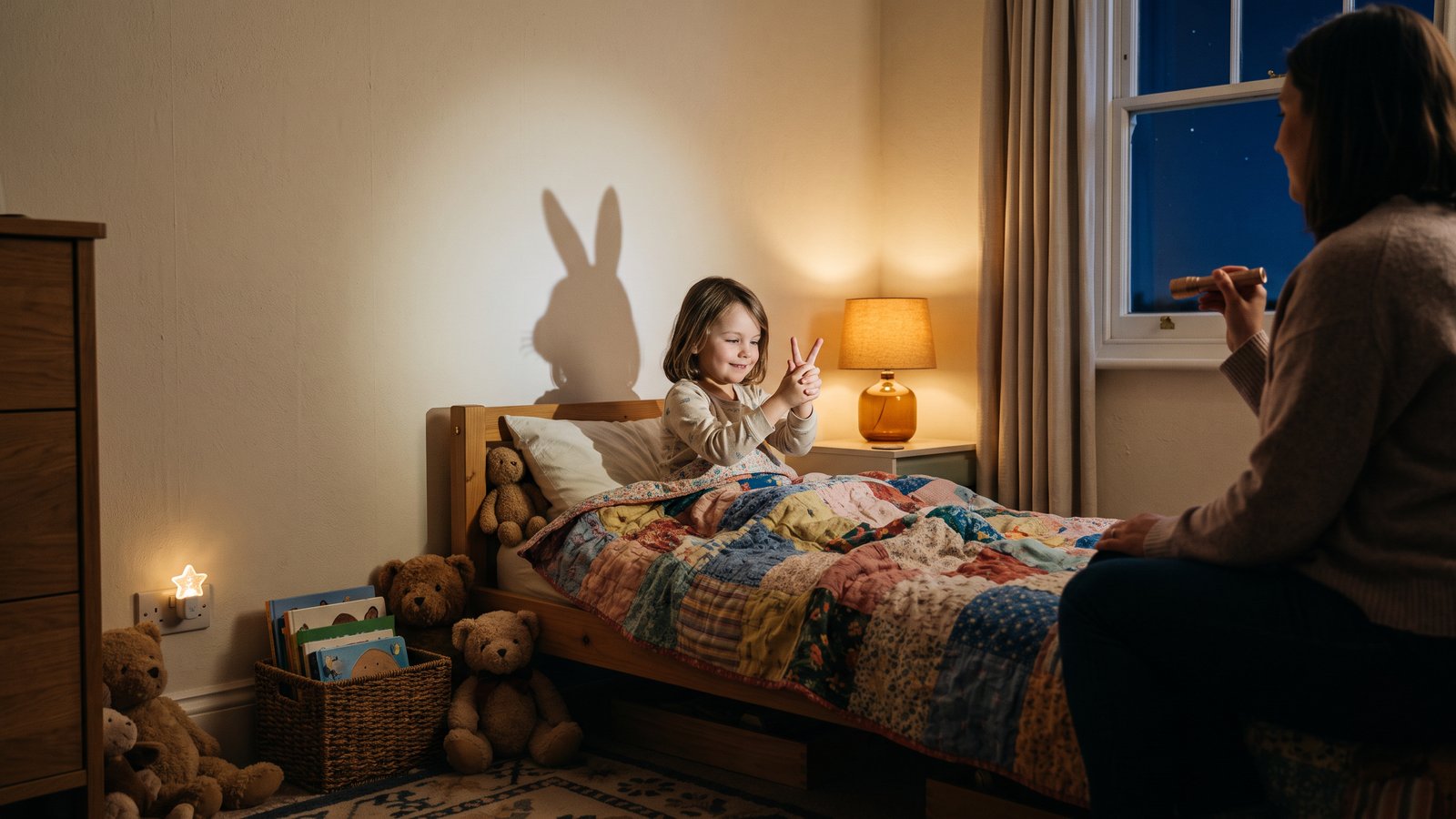
Teeth brushed. Two books read, maybe three. The light goes off, you get as far as the door, and a small voice stops you. "Can you leave it open? A bit more. Is the hall light on? What's that shape on the chair?"
If you're living with a child afraid of the dark, you have a lot of company. Night fears are an ordinary part of being 4 to 9. That doesn't make bedtime any shorter. But a fear of the dark, by itself, isn't a sign anything has gone wrong.
Here's the short version. Fear of the dark is a common, normal part of growing up, and for most children it eases over time, though not always in a straight line. The gentlest approach is to take the fear seriously without making it bigger: listen, comfort, keep a dim light on if it helps, and let your child get to know the dark in small, playful steps, starting in the daytime with you beside them.
If you only have a minute
- Tonight: say one calm line, like "The dark can feel scary. I'm right here, and you're safe." Leave a soft, dim light on, or the door open, if it helps. Pick one goodnight line and say it the same way each night, like "The door is open, the light is soft, and I'm close by." (That last one is our own idea.)
- This weekend: over breakfast or on a walk, ask what the scary part is, or let your child draw it. If your child is up for it, try one short flashlight game in a dim room, even 30 seconds, and stop while it's still fun.
How common fear of the dark really is
In a 2001 study, a team that included psychologist Peter Muris interviewed 176 children aged 4 to 12, along with their parents, about fears at night. About three in four of the children, 73.3%, said they had them. That covers any fear at night, not only the dark.
The American Academy of Pediatrics lists "a fear of being alone in the dark" among the common fears of childhood. A 2000 review of a century of research on children's fears calls ordinary fear a normal and useful part of development, and finds that, across childhood as a whole, fears tend to shrink with age and specific fears come and go.
The 2001 study also found that parents markedly underestimated how often their children had night fears, compared with what the children themselves said. That isn't a parenting failure. A child may be carrying more at bedtime than shows, and nobody can see all of it. A gentle question in the daytime is a good place to start.
How the fear changes between 4 and 9
Two studies of children aged 4 to 12, by some of the same researchers, found the same rise. One asked about fears and scary dreams in general, the other about fears at night. Both found these fears common at 4 to 6 and even more common at 7 to 9. In the first study they became less common again at 10 to 12, and in the night-fears study they held fairly steady. These studies compared different children at different ages, so they can't tell us what any one child will do. But they do suggest that a seven-year-old who slept happily in the dark last year and now wants the hall light on isn't necessarily going backwards.
What children fear changes too. In the first of those studies, fears and scary dreams about imaginary creatures became less common with age, while worries, like worrying about a test, grew more common in older children. In a separate study of children and teenagers aged 8 to 16, fear of an intruder was the most often reported night fear.
What helps a child afraid of the dark
Some of these ideas have research behind them, some come from children's doctors, and we'll say which is which.
Take the fear seriously, without making it bigger. The American Academy of Pediatrics keeps it short: talk with your child about their worries and be sympathetic, don't belittle or ridicule the fear, and don't pressure them into being brave. "There's nothing to be scared of, you're a big kid now" is meant kindly, but it can sound like the fear itself is wrong. "The dark can feel scary. I'm right here, and you're safe" tells your child the feeling is allowed, and that you aren't worried.
Talk about it in the daytime. Children's Hospital Colorado suggests talking about fears earlier in the day, not right before bed. Ask what the scary part actually is, or let your child draw it. "The dark" can turn out to be something more specific: a shape on the door, a creak in the hallway, a story a friend told.
Make the dark a place to play. This idea has the most research behind it, though mostly for children whose fears are strong. A 2021 review of 25 years of treatment studies found 12, nine of them randomized trials, and reported that night fears improved with behavioral and cognitive-behavioral approaches, which covers things like step-by-step practice and coping skills. Those were structured programs, so the games below are our home-sized version, not something that was tested.
At home, that might look like a flashlight treasure hunt in a dim room, shadow animals on the wall, or a blanket fort with the lights off. Start with seconds, not minutes. Children's Hospital Colorado suggests daytime practice as short as 30 seconds. Let your child set the pace, and stop while it's still fun.
Autumn brings darker evenings, too: this year, clocks go back on October 25 in the UK and the EU, and on November 1 in the US. If your child is up for it, a short evening walk with a flashlight, looking for the first star, is a gentle way to spend time in the dusk together.
Give a soft toy a job. A research team at Tel Aviv University gave 104 children aged 4 to 6, all with significant night fears, a soft toy puppy. Some were asked to take care of it, others were told it would protect them. Night fears dropped about equally in both groups, more than in children still waiting to start, and the improvement lasted six months. It's one study, with children whose fears were strong, but a sweet one: looking after the toy helped about as much as being looked after by it.
Keep a light on if it helps. A soft, dim light is a reasonable comfort, and there's no need to turn it into a battle. We couldn't find a study that settles the night light question, and expert advice varies a little on the details, which we've set out in the questions below.
Comfort first, then small steps. After a nightmare, the American Academy of Pediatrics suggests going to your child quickly and letting them know you're there. Comfort comes first. The brave steps come gradually, mostly in the daytime, at your child's speed. And some nights you'll skip all of this and just sit on the edge of the bed. That counts as comfort too.
Two ideas to try if they suit your child
Let the comfort fit your child's age. A bit of playful magic, like deciding the scary creature is a friendly ghost, may suit a four-year-old. A daylight look in the wardrobe with a flashlight may suit an older child. The idea comes from a small 2009 study at the University of California, Davis: when children around 4, 5 and 7 heard stories about a child meeting a scary creature, the younger ones more often suggested pretend fixes and the older ones more often suggested reminding yourself what's real. That's what children said, not what lowered anyone's fear, so take it as an idea, not a rule.
A word about monster spray. A Seattle Children's Hospital handout says many families find a bottle of plain water labeled "monster spray" a wonderful way to help with bedtime fears. Others worry it can suggest there's something there to spray. We couldn't find any study of the spray itself. Watch how your child takes it. If it brings relief, good. If it leads to "So monsters ARE real?", let it go.
If your child sleeps in your room or your bed
Where your child sleeps is up to your family. In lots of homes, and lots of countries, sharing a room or a bed is simply how the family sleeps. One children's hospital guide advises against sharing a bed and suggests gently guiding a child back to their own bed. That advice is for families who want their child to sleep alone. If sleeping close together works for everyone, there's nothing here you need to fix.
If it isn't working, or your child used to be happy in their own bed and now finds it hard, one gentle way is to go slowly: sit beside the bed, then by the door, then just outside it, moving on only when your child is ready. If a night goes badly, you can go back a step. That's a common practical approach, and it isn't part of the program in the study below. The aim is for their own bed to feel safe, without anyone feeling pushed out.
If you'd like to change where your child sleeps, there is some research on helping children who sleep with their parents because of intense night fears. In a randomized study of 68 children aged 4 to 6, a short parent-led program, a therapy-style workbook plus a doll, did better than waiting, and the gains held three months later. It's one study, and most of the measures were parent reports.
When to talk to your child's doctor
It's worth talking to your pediatrician or family doctor if the fear is stopping your child from sleeping, showing up in the daytime too, or getting in the way of everyday life, or if you're simply worried.
A softer end to the day
Children's Hospital Colorado suggests a calm routine for fear of the dark, and a predictable wind-down gives the dark a softer start (we've written about why bedtime routines matter). If you'd like something gentle for those last few minutes, our sleep music page has slow lullabies made for winding down, and Just Close Your Eyes is a quiet song about stars, owls and a safe forest at night. None of it will make the dark less dark.
The dark doesn't have to become a friend overnight. Most children make peace with it slowly: one open door, one flashlight game, one small brave step at a time. You don't have to talk your child out of the fear. Being the warm, steady person they can find in the dark is the heart of it, and if the fear stays strong, help is there.
Frequently Asked Questions
Why is my child suddenly afraid of the dark?
Night fears are common between 4 and 9, so a new fear of the dark doesn't, by itself, mean something is wrong with your child or your parenting. Studies of children aged 4 to 12 found fears even more common at 7 to 9 than at 4 to 6. It's worth asking what's new in their world. If it started after something upsetting, or you're simply worried, it's fine to call your doctor.
How do I help a child who is afraid of the dark?
Listen and take the fear seriously, without teasing or pushing your child to be brave. Keep a dim light on if it helps, talk about the fear in the daytime, and try short, playful games in the dark at your child's pace.
Is it okay for my child to sleep with a night light?
Usually, yes. We couldn't find a study that settles it. The American Academy of Pediatrics says a light is fine after a nightmare if it helps, Seattle Children's says a night light is fine as long as it doesn't stop your child falling asleep, and Children's Hospital Colorado suggests one dim light at most.
What is a good book for a child afraid of the dark?
Look for a gentle story where a small character is met with patience and finds good things in the dark, like Martin Waddell's Can't You Sleep, Little Bear? or Jill Tomlinson's The Owl Who Was Afraid of the Dark. We couldn't find a study that tested ordinary picture books. Three small studies we found used a parent workbook, Uncle Lightfoot, Flip That Switch, with a practice game in each chapter, over several weeks, with children whose night fears were above average or strong. In one of them, the more time children spent on the games, the more their night-time behavior and separation worries improved, so the games seem to matter. Researchers say bigger, randomized studies are still needed.
Want to keep reading?
 After-School Restraint Collapse: Why Your Child Falls Apart the Second They See You
 What Pretend Play Is Quietly Teaching Your Child
 Why Outdoor Play Does More for Your Child Than You Think
 Why Boredom Is the Best Thing You Can Give Your Child This Year
 Why Bedtime Routines Matter More Than You Think (And What Science Says You Should Include)
 The Rise of Slow Media for Kids: Why What They Watch Matters More Than How Long
 Do Songs Really Help Kids Learn? The Science Behind Music and Early Literacy
 Classical Music and Children's Brains: What the Research Actually Shows
 The Dark Origins of 8 Classic Nursery Rhymes (And Gentler Versions Your Kids Actually Deserve)
 The Screen Time Question No One’s Really Asking
 Why Your Toddler Won’t Sleep: The Science of Sensory Regulation and the “Odora Method”
 Screen Time with a Purpose: How to Turn Watching into Learning 📱💡✨
 Raising Kind Hearts: Why Emotional Intelligence Matters More Than Ever 💖🌍✨
 Meet the Guardians of Kittelfdora: Where Music Meets Meaning
 Why We Built Kittelfdora Kids: A Galaxy of Imagination for Every Child