The Lantern Post
Teach Children Gratitude Without Forcing a 'Thank You'
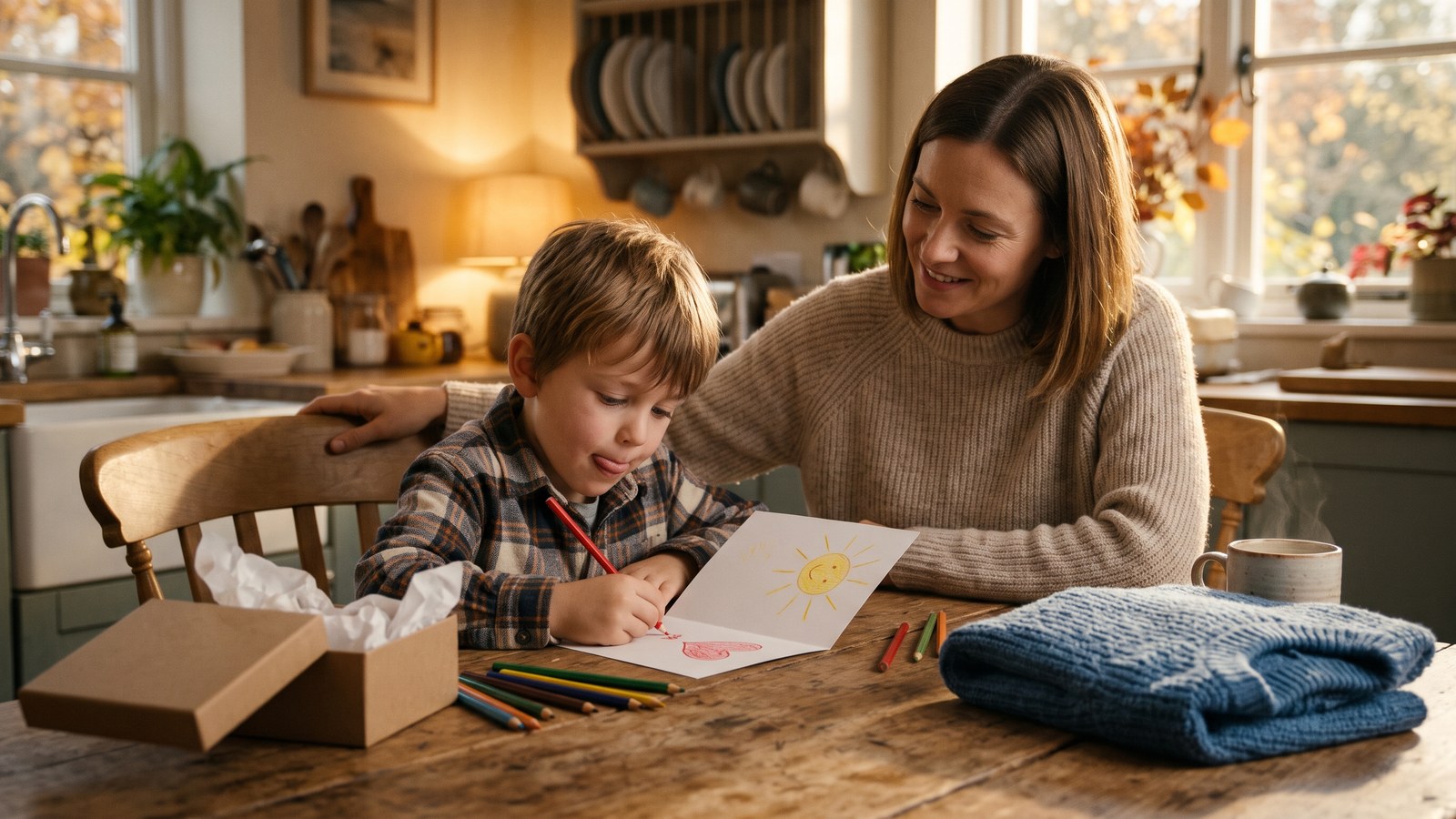
The gift is open. It's a sweater, and it's not the one your child was hoping for. You say it, in the voice every parent has: "What do we say?"
A mumbled "thanks." Was that gratitude? Maybe, maybe not yet, and either one is normal. If your child says it when you ask, nothing is wrong with them or with you. A prompted thank you is a first step many children take. (That's our view, not a study result.)
If you only have a minute
- Before the visit: agree on one short line your child can say, like "Thank you for thinking of me." It's usually true even when the gift isn't a hit.
- When the gift comes out: say one soft thing about the giver, to your child, with no answer needed. "Grandma picked this out for you."
- If it's a flop: that's okay. A child can say a polite thank you without loving the sweater. Talk about the rest later, in private.
- Check the basics first. Tired, hungry and overwhelmed children aren't at their most thankful, and holidays tend to bring all three. (Our view.)
These are our suggestions, not tested methods. Most of the research we found is about children aged 6 to 9, so these are our ideas, adapted for younger ones.
What to try this week
- Ask how it feels, and let any answer be a real answer. "How are you feeling about this one?" leaves room for "happy," "not sure" or "I wanted something else." Ask later or in private, not while Grandma's watching. For 4- and 5-year-olds, offer a choice: "A happy one, a so-so one, or a not-yet one?" (Our idea.)
- Plan for the blunt moment. If your child says "I don't like it" in front of Grandma, you can say, "Thank you, we love that you thought of us." Later, privately and calmly, tell your child: "You didn't like it. That's okay to feel. Nobody is in trouble." (Our suggestion.)
- Keep the line small. For 4- and 5-year-olds, pick a short one, practise it at home, and don't require eye contact or a hug. If speaking is too much, a wave, a drawing or a note afterward counts. (Our idea.)
Some children, such as some autistic, anxious or shy children, find naming a feeling on the spot very hard. A choice or a picture can work, and so can skipping the question. And we'd skip "Think of the children who have nothing." It tends to bring guilt, not the warm feeling you're after. (Our opinion.)
What the research says, and what it doesn't
Research on gratitude in young children is a small field. None of the studies we read tests whether prompting a thank you helps or hurts. Families show thanks in different ways, and yours may too. Here is what we found.
Andrea Hussong, a psychology professor at the University of North Carolina at Chapel Hill, describes gratitude in four parts: notice what you received, think about why, feel something about it, and do something to show it. In a 2017 magazine article she described what about 100 parents of 6- to 9-year-olds wrote in their diaries. Eighty-five percent encouraged thank-yous in ways consistent with good manners, and 39 percent went beyond manners. Manners were the most common thing parents wrote down. That isn't a failing. The four parts are her model, not a proven recipe.
A team led by Jackie Nelson (University of Texas at Dallas, per the paper) followed 263 children. Those who understood emotions and other people's thoughts better at ages 3 and 4 understood more about gratitude at age 5. That's an association, not proof, and it measured understanding, not whether children said or felt thanks.
In a 2022 study, 43 parent and child pairs talked about gratitude. The children, around ten and eleven, said they couldn't always be grateful. They said they felt it when a gift was special, enjoyable, unique or unexpected, or when they knew it would make a parent happy.
So a child who doesn't love the sweater isn't failing at gratitude. Some children, with time and a little help noticing, may feel something warm about the part that's about Grandma: she thought of them. Some won't today, and that's fine too. (That's our reading, not the study's.)
If you want more
For a gentle way into feelings, our Garden of Feelings has emotion games where children guess what Miri and Ori are feeling. And if the holidays have everyone running on fumes, you might like our post on why kids fall apart at home.
Frequently Asked Questions
At what age do children understand gratitude?
Some understanding shows up early. In one study, most 5-year-olds understood at least some aspects of when thanks are called for, though they varied widely. For 4-year-olds we found nothing on gratitude itself.
Should I make my child say thank you?
It's your call, and we couldn't find a study that says it helps or hurts. A polite thank you is good manners. Our idea: agree on a simple line before the gift is opened, so there's no put-on-the-spot moment.
My child doesn't seem thankful. What can I do?
Check first whether they're tired, hungry or overwhelmed. Then try the small things above, and don't demand a feeling. Children are never required to feel grateful for the basics they're owed, like food, a home and care.
Want to keep reading?
 Afraid of the Dark? How to Help a Child Ages 4 to 9 Feel Safe at Bedtime
 After-School Restraint Collapse: Why Your Child Falls Apart the Second They See You
 What Pretend Play Is Quietly Teaching Your Child
 Why Outdoor Play Does More for Your Child Than You Think
 Why Boredom Is the Best Thing You Can Give Your Child This Year
 Why Bedtime Routines Matter More Than You Think (And What Science Says You Should Include)
 The Rise of Slow Media for Kids: Why What They Watch Matters More Than How Long
 Do Songs Really Help Kids Learn? The Science Behind Music and Early Literacy
 Classical Music and Children's Brains: What the Research Actually Shows
 The Dark Origins of 8 Classic Nursery Rhymes (And Gentler Versions Your Kids Actually Deserve)
 The Screen Time Question No One’s Really Asking
 Why Your Toddler Won’t Sleep: The Science of Sensory Regulation and the “Odora Method”
 Screen Time with a Purpose: How to Turn Watching into Learning 📱💡✨
 Raising Kind Hearts: Why Emotional Intelligence Matters More Than Ever 💖🌍✨
 Meet the Guardians of Kittelfdora: Where Music Meets Meaning
 Why We Built Kittelfdora Kids: A Galaxy of Imagination for Every Child